Live streaming failures rarely happen at the player. They happen earlier, inside the stream pipeline. Packet loss, unstable ingest, protocol mismatches, and poor transcoding decisions quietly degrade quality long before a viewer clicks play. Wowza’s strength lies in how it structures and stabilizes that pipeline from start to finish.

4
What a stream pipeline really is
A live stream is not a single action. It is a sequence of steps, each dependent on the one before it. In professional environments, this sequence is referred to as a pipeline.
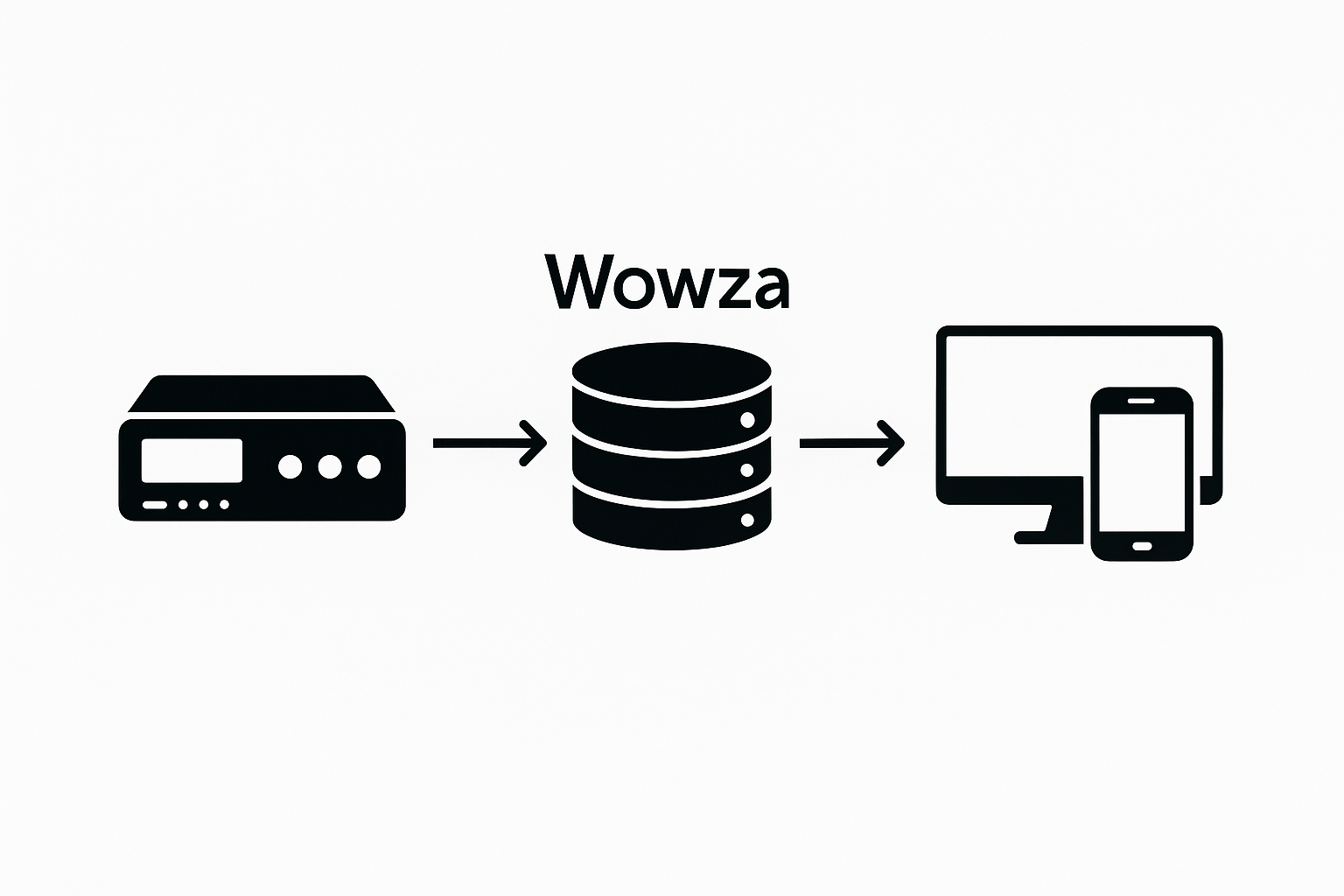
A typical Wowza-powered pipeline includes:
- Ingest from an encoder or browser
- Stream validation and buffering
- Optional transcoding
- Protocol conversion
- Delivery to viewers or CDNs
Each step introduces potential points of failure. Wowza’s design minimizes disruption by keeping these stages modular and predictable.
Ingest: where most problems begin
Ingest is the most fragile part of live streaming. Encoders vary in quality, networks fluctuate, and latency requirements differ by use case. Wowza supports multiple ingest protocols precisely because no single protocol fits all scenarios.
RTMP remains dominant for studio-based workflows due to its reliability and wide encoder support. SRT is increasingly used for contribution feeds over unstable networks. WebRTC serves ultra-low-latency use cases. Wowza does not force a choice. It accepts multiple ingest paths simultaneously.
This flexibility allows operators to adapt pipelines without redesigning the system. An RTMP ingest today can become an SRT ingest tomorrow, while downstream delivery remains unchanged.
Stream processing and internal handling
Once a stream enters Wowza, it is no longer a raw feed. The engine applies internal buffering, timestamp correction, and stream health checks. These processes are invisible to viewers but critical for stability.
Unlike lightweight relay servers, Wowza maintains control over stream state. It knows when a feed drops, when timestamps drift, and when a fallback should be triggered. This internal awareness is why Wowza pipelines behave predictably under stress.
Transcoding decisions and trade-offs
Transcoding is optional, but when used incorrectly, it can destroy performance. Wowza allows operators to choose whether to transcode on the server, at the encoder, or not at all.
Server-side transcoding offers flexibility but increases CPU load. Encoder-side transcoding reduces server stress but limits adaptability. Wowza does not prescribe a single approach. It enables multiple models depending on scale and budget.
For hosting environments where efficiency matters, many providers tune Wowza pipelines to minimize unnecessary transcoding. Providers like Red5Server often design pipelines that balance quality and cost by pushing encoding logic closer to the source:
https://www.red5server.com/wowza-servers/
Protocol conversion as a core function
One of Wowza’s defining roles is protocol conversion. Most viewers no longer consume RTMP directly. They rely on HLS or MPEG-DASH delivered over HTTP.
Wowza sits between these worlds. It accepts contribution protocols optimized for production and outputs delivery protocols optimized for playback. This separation allows each side of the pipeline to evolve independently.
For example:
- Ingest remains RTMP or SRT
- Delivery shifts from HLS to low-latency HLS
- DASH is added for specific devices
The pipeline adapts without forcing a rebuild.
Delivery optimization and viewer experience
Delivery is often outsourced to CDNs, but the quality of delivery still depends on how streams are packaged. Segment length, playlist updates, and keyframe alignment all affect playback smoothness.
Wowza exposes these parameters, allowing fine-tuning based on audience behavior. Sports streams prioritize low latency. Educational streams prioritize stability. Corporate streams prioritize compatibility.
Hosting providers specializing in Wowza environments often preconfigure these settings based on use case. For an overview of how such delivery-focused configurations are offered, see this explanation from
Stream pipelines and scaling logic
Scaling a stream pipeline is not just about adding bandwidth. It is about deciding where replication occurs. Wowza pipelines can scale vertically on a single server or horizontally across multiple nodes.
Common strategies include:
- Origin and edge separation
- CDN offloading
- Regional replication
Wowza’s predictable pipeline behavior makes it easier to design these strategies without unexpected side effects.
Comparing Wowza pipelines to simplified streaming stacks
| Aspect | Simplified stacks | Wowza pipelines |
|---|---|---|
| Ingest flexibility | Limited | Broad |
| Protocol conversion | Minimal | Core feature |
| Failure handling | Reactive | Proactive |
| Custom tuning | Low | High |
| Long-term adaptability | Weak | Strong |
This comparison explains why Wowza pipelines are often chosen for systems expected to evolve over years, not months.
Independent technical references
For a neutral, historical overview of Wowza’s role in streaming pipelines, Wikipedia provides a concise summary of the engine’s evolution and design philosophy:
https://en.wikipedia.org/wiki/Wowza_Media_Systems
For hands-on demonstrations of ingest paths, transcoding options, and delivery tuning, the official Wowza YouTube channel offers technical walkthroughs suitable for engineers and system administrators.
Internal link within the Wowza cluster
This article focuses on how streams move through Wowza. A complementary perspective is explored on wowzaservers.com, where the emphasis shifts to server sizing, capacity planning, and hardware considerations that support these pipelines at scale.
Closing reflection
Streaming quality is rarely improved by adding features. It is improved by respecting the pipeline. Wowza’s enduring relevance comes from how carefully it manages the journey from ingest to delivery, allowing operators to build systems that survive changing protocols, audiences, and expectations.